What Is a Thermally Broken Aluminium Door - and Why Does It Matter?
A thermal break prevents the inside and outside aluminium sections of a door frame from creating a direct path for heat. Learn how this improves comfort, efficiency and condensation resistance.
If you have been researching aluminium bifold, sliding or entrance doors, you will probably have encountered the term thermally broken.
It is frequently listed alongside U-values, glazing specifications and weather testing, but the phrase is not always explained clearly.
A thermal break is an insulating section built into an aluminium frame. It separates the metal facing the outside of the property from the metal facing the room, reducing the amount of heat that can travel directly through the frame.
This detail is essential for external aluminium doors. It helps modern systems provide the strength and slim profiles associated with aluminium without repeating the cold-frame and condensation problems found in many older metal windows and doors.
Why Does Aluminium Need a Thermal Break?
Aluminium is an excellent material for constructing large doors because it is strong, stable and relatively lightweight.
It can support substantial glazed panels while maintaining slimmer frame sections than many alternative materials.
However, aluminium is also an effective conductor. This means heat can pass through it relatively easily.
If an external door frame were manufactured from one continuous piece of aluminium running from outside to inside, it would create a direct path through the thermal envelope of the building.
During winter:
-
The exterior section of the frame is exposed to cold outdoor temperatures.
-
Heat from the room can travel through the aluminium towards the colder exterior.
-
The internal face of the frame may become noticeably colder.
-
Condensation may form if the internal surface falls below the dew-point temperature.
During hot weather, the process can operate in the opposite direction, with heat from the exterior passing towards the room.
A thermal break interrupts this direct metal pathway.
What Is a Thermal Break?
In a thermally broken aluminium profile, the frame is divided into separate internal and external aluminium sections.
These sections are connected using a material that transfers heat far less readily than aluminium.
Depending on the product, this insulating section may consist of:
-
A reinforced polyamide strip
-
A resin-based insulating section
-
A specialist foam or composite insert
-
A combination of insulating chambers and materials
The insulating section is contained within the frame profile and is normally hidden once the door has been assembled.
It keeps the internal and external aluminium structurally connected while reducing the amount of thermal energy passing between them.
How Is a Thermally Broken Frame Constructed?
The exact manufacturing process differs between systems, but a typical thermally broken profile contains:
-
An exterior aluminium extrusion
-
An interior aluminium extrusion
-
One or more insulating strips connecting the two sections
-
Internal chambers that increase the path heat must travel
-
Gaskets and seals surrounding the glazing and opening panels
The insulating strips are mechanically secured within specially formed channels in the aluminium.
The result is one complete frame with the structural rigidity needed to support the glass and hardware, but without one uninterrupted piece of metal running from the outside surface to the inside.
Can You See the Thermal Break?
Usually, no.
The thermal break is located within the frame profile. Once the door has been assembled, glazed and installed, it is not normally visible during everyday use.
It does not prevent the frame from being:
-
Powder-coated in a wide range of colours
-
Produced with different internal and external finishes
-
Manufactured with slim sightlines
-
Used for bifold, sliding, French or entrance doors
The easiest way to see the thermal break is through a cutaway sample or technical cross-section of the frame.
On a cross-section, it normally appears as one or more non-metallic sections positioned between the inner and outer aluminium extrusions.
What Difference Does a Thermal Break Make?
It Reduces Heat Transfer Through the Frame
The main purpose of the thermal break is to reduce the amount of heat passing through the aluminium profile.
This helps the complete door achieve better thermal performance than a comparable frame made from continuous, unbroken aluminium.
The improvement applies to the frame rather than the glass alone. This is important because the overall performance of a glazed door includes both elements.
It Keeps the Internal Frame Surface Warmer
During cold weather, the inside surface of a thermally broken frame should remain warmer than the internal surface of a non-thermally broken aluminium frame.
This can improve comfort around large door openings, particularly where furniture, a dining table or a kitchen island is positioned nearby.
It Reduces the Risk of Surface Condensation
Condensation forms when warm, moisture-containing air contacts a surface cold enough for water vapour to condense.
By keeping the inside of the aluminium frame warmer, a thermal break reduces the likelihood of the frame reaching that critical temperature.
It does not make condensation impossible. Humidity, ventilation, external temperature, glazing performance and installation details all remain important.
It Supports Building-Efficiency Requirements
External doors form part of the thermal envelope of a home.
A thermally broken frame, suitable insulated glazing and effective perimeter seals help the complete door achieve the thermal performance required for the project.
It Can Improve Summer Comfort
A thermal break works in both directions. As well as reducing winter heat loss, it limits heat travelling through the aluminium from a hot exterior surface towards the interior.
However, the majority of summer heat entering a large glazed opening may pass through the glass rather than the relatively narrow frame sections.
Solar-control glass, orientation, shading and ventilation should therefore be considered alongside the thermal break.
Thermally Broken Does Not Mean Draught-Proof
A thermal break reduces heat travelling through the material of the frame. It does not, by itself, prevent air leaking around the door.
Draught resistance depends on:
-
The design of the weather seals
-
The compression achieved when the door is locked
-
The alignment of the opening panels
-
The threshold arrangement
-
The quality of the installation
-
The sealing between the outer frame and building
A thermally broken door could still feel draughty if it has been measured, installed or adjusted incorrectly.
Similarly, a door may seal effectively against air leakage but still perform poorly through its materials if the frame lacks a suitable thermal break.
Both thermal insulation and airtightness matter.
Thermally Broken Does Not Describe the Glass
The phrase thermally broken refers primarily to the aluminium frame construction.
The glass has its own thermal specification.
An external aluminium door may be fitted with:
-
Double glazing
-
Triple glazing
-
Low-emissivity coatings
-
Argon or another gas within the sealed cavity
-
Warm-edge spacer bars
-
Laminated, acoustic or solar-control glass
A strong thermal break cannot compensate for inappropriate glazing, just as high-performance glass cannot completely overcome a poor frame.
The frame and glass must be assessed as one complete door system.
Understanding U-Values
A U-value measures the rate at which heat passes through a building element.
It is expressed in watts per square metre kelvin, written as W/m²K.
A lower U-value indicates that less heat passes through the product and therefore represents better insulating performance.
When comparing aluminium doors, establish which U-value is being quoted.
You may encounter:
-
Ug-value: the thermal performance of the glass
-
Uf-value: the thermal performance of the frame
-
Ud-value: the thermal performance of the complete door
The whole-door value is normally the most useful figure when comparing complete products.
A centre-pane glass figure does not include:
-
The aluminium frame
-
The glass-edge spacer
-
The meeting sections between panels
-
The threshold
-
Other junctions within the door
It therefore should not be presented as though it represents the performance of the entire installation.
Why the Exact Door Size Affects Its U-Value
The thermal performance of a glazed door can change with its dimensions and configuration.
A larger door may contain a greater proportion of glass, while a smaller or multi-panel arrangement may contain proportionally more frame.
The result can also be influenced by:
-
The number of panels
-
The number of meeting stiles
-
The frame depth and thermal-break design
-
The glass thickness and coating
-
The spacer bar around the glazing
-
The threshold type
-
Whether the product is fixed or opening
For this reason, avoid comparing one manufacturer’s best published result with a quotation for a completely different size or panel arrangement.
Ask for the thermal performance applying to the proposed specification wherever it is available.
Do All Modern Aluminium Doors Have Thermal Breaks?
No.
Thermally broken profiles are standard across many quality residential exterior-door ranges, but not every aluminium product is designed for the same purpose.
Non-thermally broken aluminium may still be used for:
-
Internal glazed doors
-
Office partitions
-
Unheated outbuildings
-
Some commercial applications
-
Decorative screens
-
Spaces where the frame does not separate heated accommodation from outside
An internal door between two rooms at similar temperatures does not usually require the same thermal construction as an external bifold or sliding door.
Do not assume that a product is thermally broken merely because it is made from aluminium or described as premium.
Check the technical specification.
Which External Products Should Be Thermally Broken?
Thermal breaks are relevant to aluminium products forming part of the external envelope of a heated building.
These commonly include:
-
Aluminium bifold doors
-
Sliding patio doors
-
French doors
-
Aluminium entrance doors
-
External aluminium windows
-
Corner door systems
-
Roof lights and roof lanterns
Where a product separates a heated room from the exterior, its complete thermal specification should be considered.
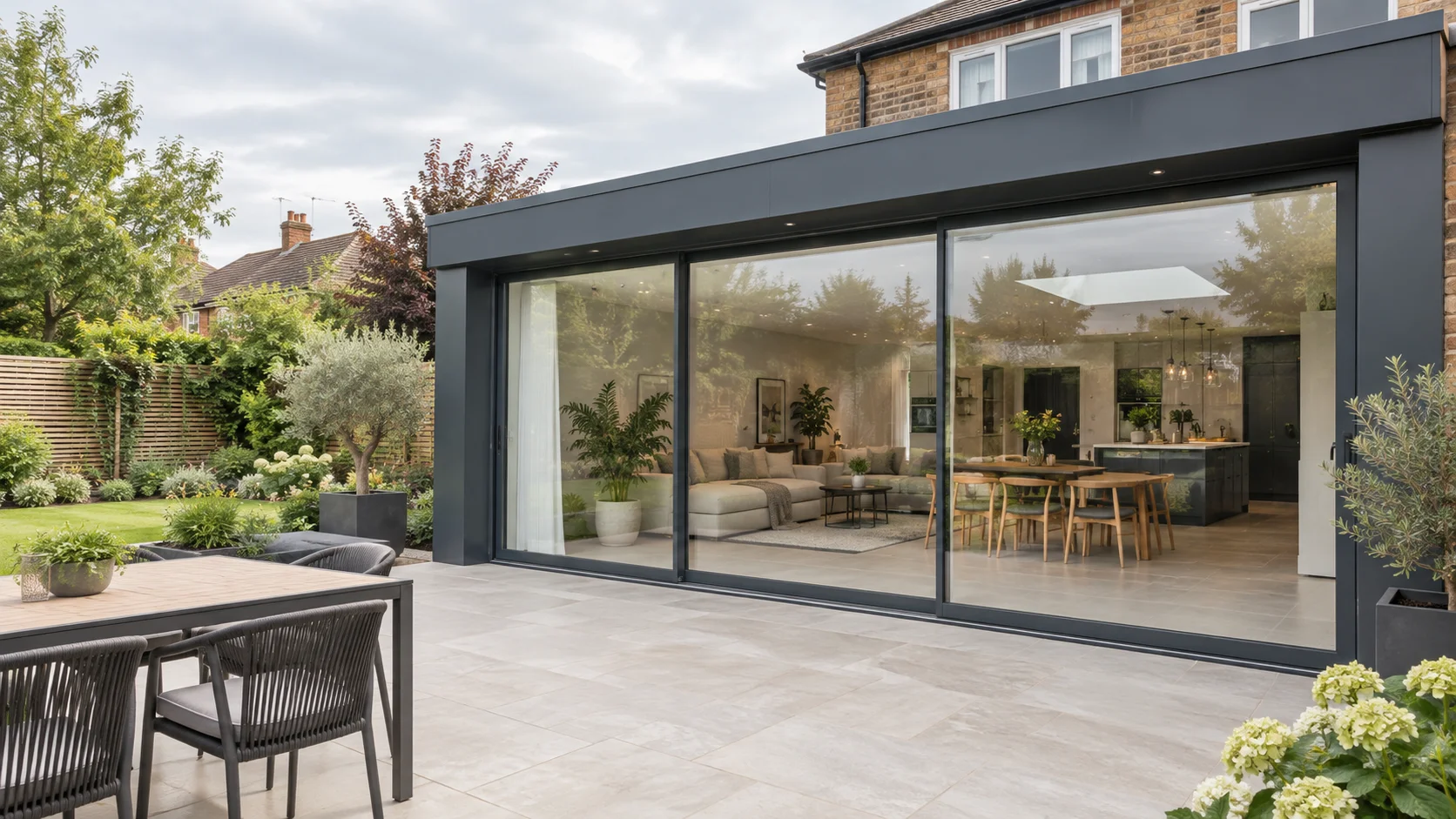
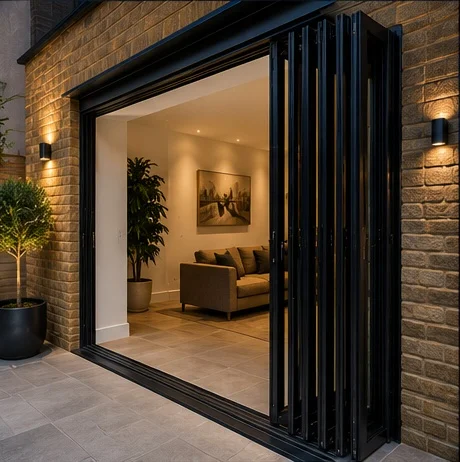
Thermal Breaks in Bifold Doors
Bifold doors contain several individual panels connected by hinges.
This creates multiple vertical frame junctions across a larger opening, making the thermal design of the profiles particularly important.
A thermally efficient bifold system should combine:
-
Thermally broken panel and outer-frame profiles
-
Suitable insulated glazing
-
Continuous weather seals
-
Effective compression between closed panels
-
A well-designed threshold
-
Correct adjustment of the hinges and locking points
The number of panels and visible frame sections can affect the overall result, so compare the whole-door figure for the arrangement you are considering.
Thermal Breaks in Sliding Doors
Sliding doors generally contain fewer but larger glass panels than bifolds.
The aluminium is concentrated around the perimeter, meeting stiles and tracks.
A good sliding system should use thermally broken profiles throughout the parts separating inside from outside.
Pay particular attention to:
-
The central meeting stile
-
The lower track and threshold
-
The perimeter outer frame
-
Any interlocking panel sections
Very slim meeting stiles can look impressive, but the thermal performance of that reduced profile should still form part of the product assessment.
Thermal Breaks in Aluminium Front Doors
An entrance door may contain more solid panel material and less glass than a bifold or sliding system.
Its thermal performance depends on:
-
The thermal break within the aluminium frame
-
The insulation within the door panel
-
The amount and specification of any glazing
-
The threshold
-
The seals surrounding the opening leaf
-
How firmly the lock pulls the door against those seals
A largely solid entrance door may achieve a different result from the same product range configured with full-height glass and side panels.
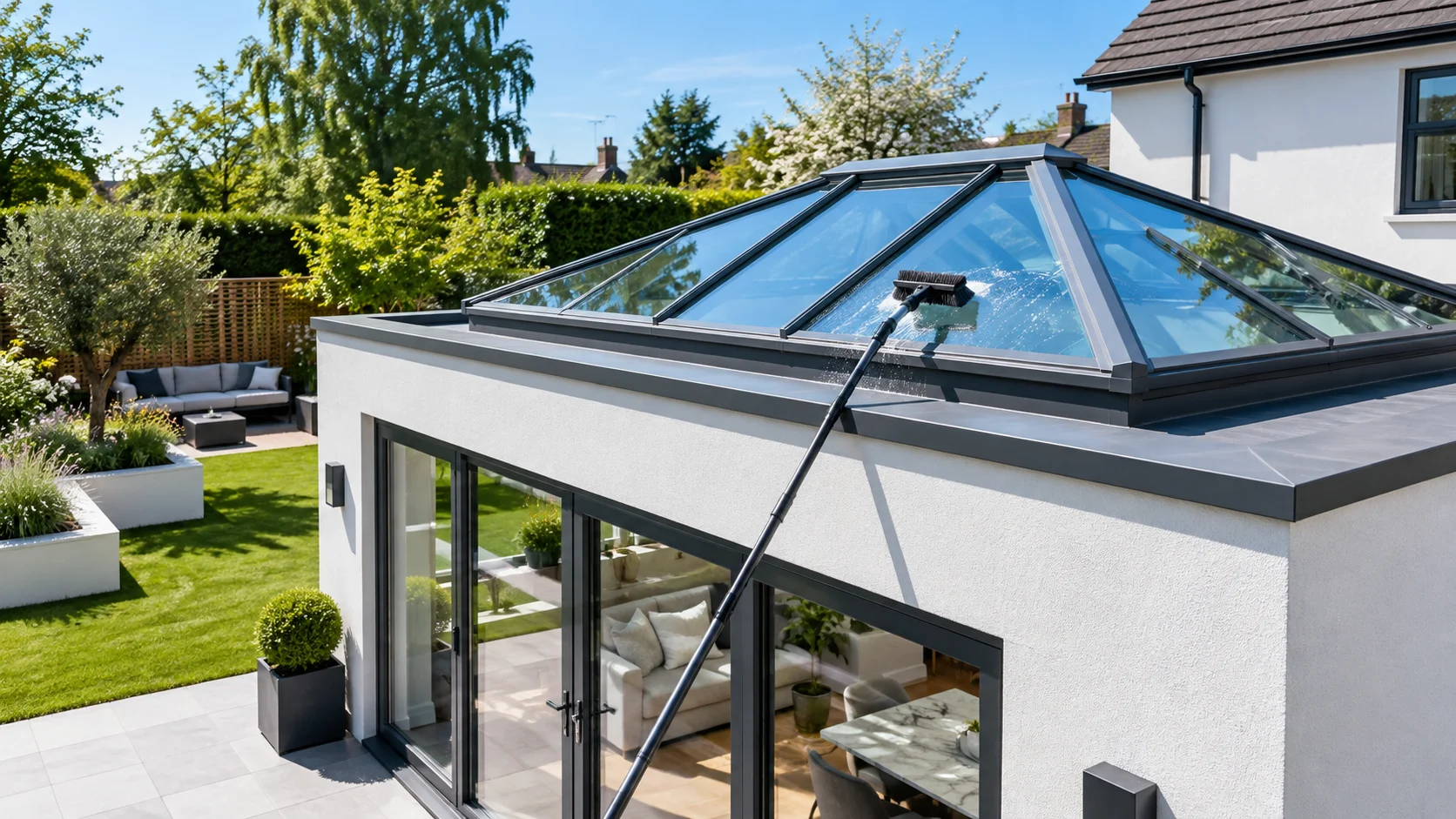
Thermal Breaks in Roof Lights and Lanterns
Aluminium roof glazing also requires careful thermal design because the frame is directly exposed to outdoor temperatures and positioned above warm indoor air.
A thermally broken frame helps keep the interior aluminium surfaces warmer and reduces thermal bridging around the glazed opening.
The roof-light or lantern must also be supported by:
-
A properly insulated upstand
-
Continuous insulation around the roof opening
-
Suitable double or triple glazing
-
Correct internal air sealing
-
Properly completed roof waterproofing
A good thermal break within the product cannot correct missing insulation within the surrounding roof construction.
What Causes Condensation on Aluminium Doors?
Condensation is influenced by surface temperature and the amount of moisture within the indoor air.
Common sources of household moisture include:
-
Cooking
-
Showering and bathing
-
Drying clothes indoors
-
Breathing and normal occupation
-
Unvented appliances
-
Moisture remaining from recent building work
A thermal break raises the internal frame temperature and therefore reduces condensation risk.
Condensation may still appear where:
-
Indoor humidity is excessively high
-
The room has insufficient ventilation
-
The external temperature is unusually low
-
Insulation is missing around the outer frame
-
The glass edge or threshold creates a colder localised area
-
The product has been installed incorrectly
Persistent condensation should therefore be investigated as a complete building issue rather than automatically attributed to one frame component.
The Installation Can Create a Thermal Bridge
Even a well-designed thermally broken door can underperform if the junction between its frame and the building is poorly detailed.
Potential problems include:
-
Large uninsulated gaps around the frame
-
Metal fixings or structural members creating localised cold bridges
-
Poorly positioned cavity closers
-
Missing insulation beneath the threshold
-
Air leakage through incomplete perimeter sealing
-
External and internal finishes trapping moisture
The frame should be installed within a correctly prepared opening, with suitable insulation and air sealing around its perimeter.
The threshold detail is especially important because it must balance accessibility, drainage, structural support and continuity of insulation.
Does a Low or Flush Threshold Affect Thermal Performance?
A low or visually flush threshold can improve accessibility and strengthen the connection between inside and outside.
However, reducing the height of the threshold may leave less space for:
-
Thermal chambers
-
Weather seals
-
Drainage channels
-
Structural frame sections
This does not mean that every low threshold performs poorly. It means the thermal and weather performance of the exact threshold option should be checked.
A flush appearance also depends on the surrounding construction, including:
-
The internal finished floor level
-
Insulation beneath the frame
-
The external paving level and fall
-
The drainage channel
-
Damp-proofing and waterproofing
Double or Triple Glazing?
A thermally broken aluminium frame can normally be combined with double or triple glazing, depending on the product.
Double Glazing
Quality double glazing may provide suitable performance for many UK homes when it is combined with an effective frame, low-emissivity coatings and warm-edge spacer bars.
Triple Glazing
Triple glazing may be beneficial where:
-
The project is targeting enhanced energy performance
-
The doors face north
-
The property is in a cold or exposed location
-
The glazed opening is particularly large
-
Improved acoustic performance is also required
Triple-glazed units are heavier and may affect:
-
The maximum permitted panel size
-
The number of panels required
-
The load placed on rollers and hinges
-
The ease of transport and installation
-
The total price
Select glazing by comparing the complete door specification rather than assuming triple glazing is automatically required.
Warm-Edge Spacer Bars
The panes within an insulated glass unit are separated around their perimeter by a spacer bar.
Traditional metallic spacer bars can create a more conductive path around the edge of the glass.
Warm-edge spacer bars use materials with lower thermal conductivity, helping improve the thermal performance around this perimeter.
This is significant because the edge of the glazing is positioned close to the aluminium frame.
A quality door specification therefore considers both:
-
The thermal break within the frame
-
The thermal performance around the edge of the glass
Does a Wider Thermal Break Always Mean Better Performance?
The size of the insulating section can influence frame performance, but width alone does not provide a complete comparison.
Thermal performance also depends on:
-
The shape of the profile
-
The number and arrangement of internal chambers
-
The material used for the insulating section
-
The relationship between the frame and glass
-
The seals and meeting sections
-
The size of the tested product
Compare verified frame or whole-door performance rather than judging a system solely by the visible width of one component.
How Does Aluminium Compare with uPVC?
uPVC is naturally less conductive than aluminium and uses multi-chambered profiles to provide thermal resistance.
Aluminium requires a designed thermal break to limit conduction through its frame.
Both materials can produce thermally efficient doors when they are properly engineered.
Aluminium generally offers:
-
Slimmer profiles
-
Greater strength for larger panels
-
Better structural stability across substantial openings
-
Extensive powder-coated colour options
uPVC generally offers:
-
A lower initial cost
-
Naturally insulating frame material
-
Established standard-size residential products
Do not assume either material will always provide the lower U-value. Compare the figures and complete specifications of the actual products.
How Does Aluminium Compare with Timber?
Timber is naturally less conductive than aluminium and can provide strong thermal performance.
Its appearance also suits many traditional and design-led properties.
Aluminium generally requires less ongoing maintenance and offers greater resistance to:
-
Swelling
-
Warping
-
Rot
-
Repeated repainting or staining requirements
A properly designed thermal break allows aluminium to combine its structural and maintenance advantages with suitable thermal performance for modern external doors.
Building Regulations and Thermal Performance
External doors installed as part of a new home, extension or replacement project may need to satisfy applicable energy-efficiency requirements.
The precise route to compliance can depend on:
-
Whether the project is a new build, extension or replacement
-
The amount of glazing included within the project
-
The performance of the surrounding building fabric
-
The UK nation in which the property is located
-
The date on which the relevant application or notice was submitted
-
Any transitional arrangements applying to the work
Building Regulations guidance is not identical across England, Wales, Scotland and Northern Ireland.
Your architect, energy assessor, installer or Building Control body should confirm the performance required for the specific project.
Do not rely on a general website statement when compliance depends on an exact product, configuration and building design.
What Should You Ask a Door Supplier?
Before ordering an external aluminium door, ask:
-
Is the complete outer frame thermally broken?
-
Are the moving-panel profiles also thermally broken?
-
What material is used within the thermal break?
-
What is the whole-door U-value?
-
Which dimensions and panel configuration were used for that figure?
-
Does the quotation include double or triple glazing?
-
What glass coating and spacer bar are included?
-
What threshold has been specified?
-
What air, water and wind testing applies to the product?
-
What installation detail is required around the frame?
A supplier should be able to provide technical information for the exact system rather than relying only on the phrase thermally broken.
Warning Signs When Comparing Aluminium Doors
Approach a quotation carefully where:
-
The supplier cannot confirm whether the frame is thermally broken.
-
Only the glass U-value is provided.
-
The quoted U-value does not identify the tested size or configuration.
-
There is no information about the glass specification.
-
The threshold option is omitted from the technical description.
-
Very different products are described using the same best-case performance figure.
-
The importance of installation and perimeter insulation is ignored.
The thermal break is important, but it should form part of a complete and transparent specification.
Is a Thermally Broken Aluminium Door Worth It?
For an external aluminium door serving a heated home, a suitable thermal break should be treated as an essential feature rather than an optional upgrade.
It allows aluminium to deliver:
-
Slim sightlines
-
Structural strength
-
Large glass panels
-
Long-term stability
-
Low maintenance
while reducing the heat transfer and cold internal surfaces associated with continuous aluminium frames.
The thermal break alone does not guarantee an efficient door. The final performance still depends on the glass, seals, threshold, dimensions and installation.
But without an effective thermal break, achieving strong residential thermal performance with an aluminium external frame becomes considerably more difficult.
Explore Thermally Efficient Aluminium Doors
Explore SmartaView’s aluminium door range to compare bifold, sliding, entrance and other external door systems.
Review the thermal specification for the exact product and dimensions you are considering. Check the whole-door U-value, glazing, spacer bar, threshold and installation requirements rather than relying on one feature or headline figure in isolation.
Further reading
- How Long Do Aluminium Doors Last? A Realistic Lifespan Guide
- Do Aluminium Doors Need Maintenance? The Honest Answer
- Are Your Windows Losing Heat? 7 Signs It's Time to Upgrade
Looking for energy-efficient aluminium doors? SmartaView makes premium aluminium glazing you can price online, with free UK mainland delivery. Browse the range or speak to our team for advice.
Author at Smartaview, writing about aluminium glazing, home improvements and the buying process.